

Scientists propose to replace Face ID with biometrics through Bluetooth headphones
22.05.26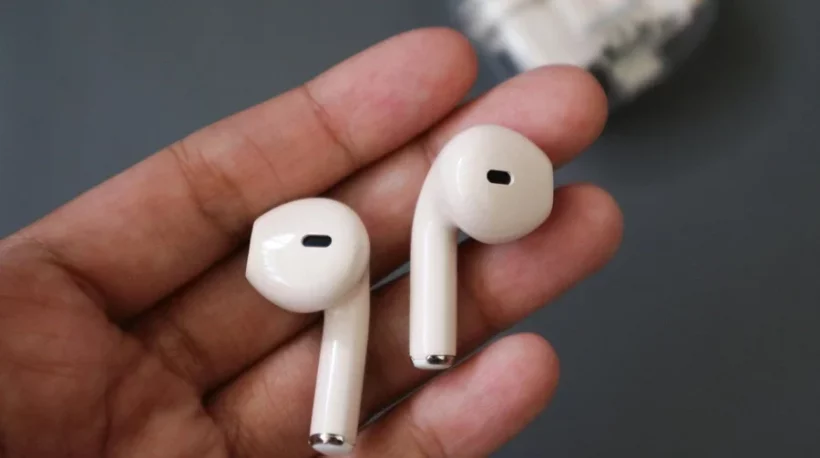
Face ID and Touch ID technologies have become an integral part of everyday data protection in portable devices. However, in the near future, this list is quite capable of being expanded by a completely contactless alternative — Ear ID. An experimental software-hardware solution with the technical name AccLock allows you to turn ordinary consumer headphones into a permanent key to confirm your identity, which uses exclusively the signals of the beating human heart.
Ear ID technology and AccLock algorithm
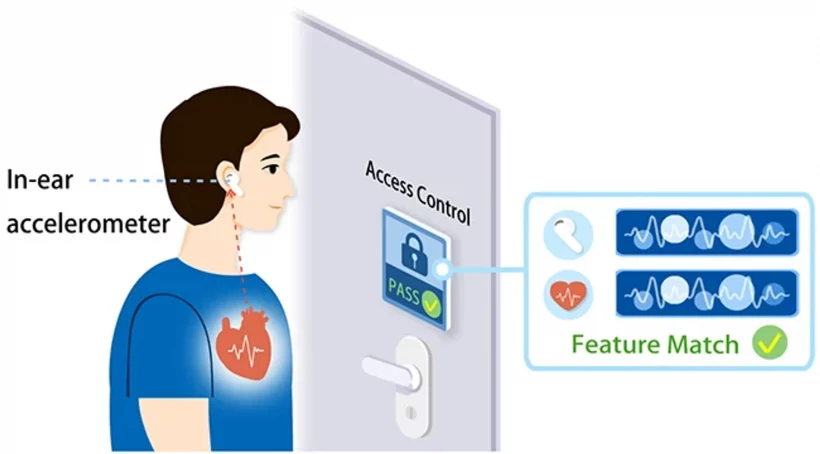
The basis of the concept called AccLock, announced by Chinese researchers, is the possibility of using a completely autonomous continuous passive authentication while the headset is in use. Checking user authentication is tied to the heart of the system. It is interesting that the revolutionary novelty does without an additional hardware infrared or photoelectric pulse sensor. To intercept biological noise, engineers used a standard coaxial sensor — a classic accelerometer, which is equipped with the vast majority of high-quality modern headsets, including AirPods.
Technical specifications
Each new contraction of the myocardium generates a slight physical impulse (ballistocardiogram), which is distributed over all the soft tissues and cartilages of the ear. This dynamic micro-noise is well read by a highly sensitive mobile position detector. During large-scale internal tests, Chinese specialists took serial models of Apple AirPods headphones and specially assembled 3D-printed analogues with ordinary chips of accelerometers at a clock frequency of 100 Hz.
- Period of creating a reference biometric print: the minimum interval of basic adjustment is about 2 minutes. Progressive adjustment of a detailed portrait to fix a personal code takes no more than 6 minutes.
- Decision Speed: The system continuously accumulates the raw signal using a 4 second measurement sliding time window. Every half second (0.5 seconds), the algorithms verify whether the headset is in the original ear.
Advantages
The emergence of the idea of creating AccLock and Ear ID systems is related to known structural holes in traditional types of protection. For example, the classic Face ID or a stored sample of human speech in many basic OSes is relatively easy to break with high-precision flat or three-dimensional photos and neural network fakes of the audio stream. In addition, standard access works only once – by opening the screen once in the tram or on a walk, then the device is completely free to view and control if the smartphone is suddenly stolen or simply snatched from your hands.
The innovative principle of ballistocardiography is born locally in the internal cartilage channel of the owner in strict harmony with human biomechanical processes — this complex cannot be reproduced, considered as hidden sensors from afar, or duplicated by third-party devices. Ear ID works secretly and permanently in the background – the software understands the change of the physical user of the wireless headphone in a few short seconds after removing it from the shell and puts a reliable instant software plug.
Key nuances of testing
Ear ID specifications have proven their accuracy in test rounds: measurement work with the direct involvement of a focus group of 33 men and women of various ages showed single minimum percentages of real failures and false blocking in all standard phases of the day – sitting work in a room, quiet street background, playback.
But despite the flawless observance of high reliability limits, the concept demonstrates a number of hardware nuances:
- The system is significantly damaged by a sports run or a fast step of the user: cyclical microactivity completely disrupts the reference frequency of capture of oscillations of arterial impulses;
- Jaw locking, chewing food, active conversation generate parasitic oscillations of the structure of similar wave deviations. To correct the shift at an early stage, the researchers largely managed to record the noise mask at the initial starts of the user’s calibration settings;
- The overall clarity factor gradually decreases over an estimated six calendar weeks of constant wearing of the headphones. The developers rightly explain this by the wear of silicone ear inserts, a change in the manner of personal fitting of the plastic case in the external ear folds, or a temporary change in our anatomical posture.
Release date and price
There is currently no reliable information about the specific commercial date of the retail announcement of the development – to date, the technology is positioned by the developers exclusively as a successful academic and research publication. The direct admission of a useful option to the mass serial market and the release based on smart OS are tied to the commercial loyalty of large platform holders and mobile brands (Apple, Google, Samsung). For their part, mobile operating system vendors should open up seamless system API access to direct reading of accelerometers with built-in Bluetooth headsets.
Scaling the described protective feature is hypothetically almost a completely free process. It is definitely not worth waiting for a serious financial fee and an increase in the cost of consumer devices in retail chains – scientists propose to carry out a complex multi-factor passive verification of software entirely at the expense of the technological elemental base (capacitor accelerometers), which is now physically integrated at the manufacturing plants.
Don't miss interesting news
Subscribe to our channels and read announcements of high-tech news, tes

Oppo A6 Pro smartphone review: ambitious

 0
0 
Creating new mid-range smartphones is no easy task. Manufacturers have to balance performance, camera capabilities, displays, and the overall cost impact of each component. How the new Oppo A6 Pro balances these factors is discussed in our review.
In-Ear headphones Active Noise Cancellation: how Oppo eliminate noise
0 
In-ear headphones remain one of the most popular form factors due to their lightweight design. However, this design is considered one of the most challenging to implement active noise cancellation (ANC). We’ll explain how Oppo solved this problem.
Windows 11 Update Breaks Games: The RGB Fix

The latest cumulative Windows 11 update has caused issues with game performance and stability. Microsoft confirmed the conflict is triggered by RGB peripheral software.
Asus Challenges MacBook Pro With Powerful ProArt Creation 16

Asus has introduced a new version of its ProArt Creation 16 laptop for professionals. The device is equipped with an AMD Ryzen AI 9 processor, 64GB of RAM, and a high-quality 120Hz OLED screen.