

80 minutes vs. 60 Years: how AI accelerated Erdesz’s primitive set conjecture
30.04.26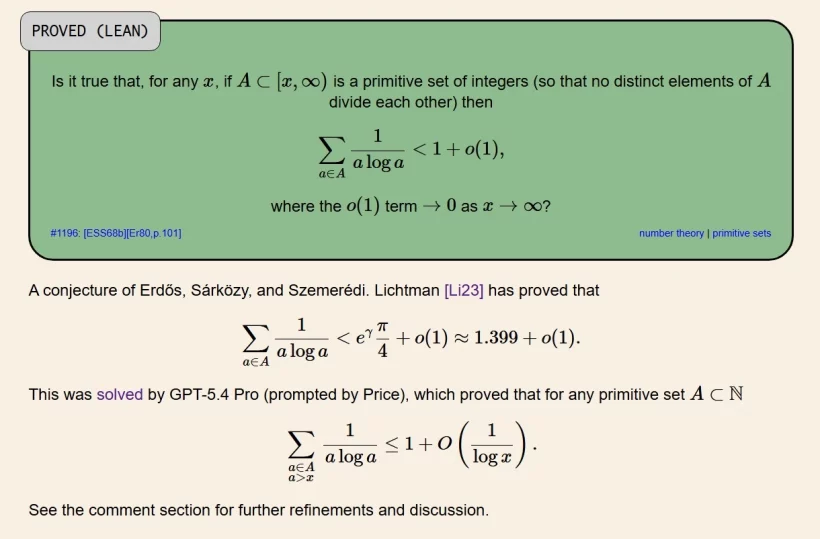
A complex mathematical hypothesis, which remained unsolved for more than half a century, received a proof thanks to the use of artificial intelligence. The key breakthrough was not computational power, but the discovery of a non-trivial approach: ChatGPT helped discover a connection with a mathematical method that had not previously been applied to this task. Once the correct reasoning vector was found, the system took only about 80 minutes to build a complete proof.
What was the problem
This is one of Pal Erdes’s hypotheses, dedicated to the so-called primitive sets – sets of natural numbers in which no element is divisible by another. Despite the simplicity of the formulation, such structures have a complex internal logic.
Erdesh assumed that a certain numerical index for these sets has a strict lower limit – unity. However, it was not possible to prove this statement for decades: researchers only gradually approached the result, but could not complete the proof.
How a new approach was found
The non-standard format of interaction with AI played a key role. 23-year-old Liam Price used the system not as a tool for calculations, but as a partner for finding ideas.
Instead of asking for a “ready-made solution”, Price set the direction – to look for unexpected, non-trivial connections and go beyond the usual methods. In the process of dialogue, unsuccessful hypotheses were screened out, until an approach was found that allowed to look at the task in a new way. After that, the AI was able to form a logically coherent proof quite quickly.
Mathematics assessment
The result aroused the interest of the professional community. The analysis was joined by leading scientists, including Terence Tao. According to them, the basis of the solution relies on a mathematical tool long known in related fields, but not previously applied to this problem.
At the same time, the original text of the proof received from the AI turned out to be difficult to understand and required serious revision. Specialists reworked it, giving it a strict form and a clear structure, while preserving the key idea.
Why it is important for science
This case shows that artificial intelligence is gradually becoming not just an auxiliary tool, but a full-fledged participant in the research process. It is able to expand the search field and suggest new directions that may elude a person.
In the long run, this changes the very approach to science: not only the amount of knowledge becomes important, but also the ability to formulate tasks, work with AI, and find non-standard solutions.
Don't miss interesting news
Subscribe to our channels and read announcements of high-tech news, tes

Oppo A6 Pro smartphone review: ambitious

 0
0 
Creating new mid-range smartphones is no easy task. Manufacturers have to balance performance, camera capabilities, displays, and the overall cost impact of each component. How the new Oppo A6 Pro balances these factors is discussed in our review.
Oppo Reno16 Pro 5G smartphone review: well-heeled
0 
Oppo Reno16 Pro 5G looks like a balanced smartphone, in which the manufacturer tried not to make a single characteristic the defining one. It has many advantages. Let’s tell you what
CD Projekt RED Keeps Momentum: The Witcher and Cyberpunk Hit New Records

CD Projekt RED revealed its H1 2026 results, reporting on The Witcher and Cyberpunk 2077 sales and player interest in new projects.
Gemini, Keep, and Motion Assist: The New Android Drop Features

Google introduced a fresh package of Android Drop updates for smartphone users, including AI integration in search, new messaging capabilities, and health-related features.